How to Plan a Memorable Eid al-Fitr Celebration Party for Family (Step-by-Step Guide)
The Chaos Nobody Warns You About
It's the night before Eid al-Fitr. You've been fasting for 29 days, your house smells like biryani and sheer khurma, and your phone is buzzing nonstop. Aunt Fatima just texted that she's bringing six extra people. Uncle Tariq still hasn't confirmed if he's coming. The kids' new Eid outfits are somewhere in a shopping bag you can't find, and you have no idea how many chairs to set up for tomorrow's gathering.
Sound familiar? Planning an Eid al-Fitr celebration for family is one of the most joyful — and most stressful — events of the year. The holiday marks the end of Ramadan, a month of fasting, reflection, and community, and the celebration deserves to match its significance. But without proper planning, the day can spiral into confusion, last-minute scrambles, and frayed nerves — right when you want to feel your most grateful and present.
This guide will walk you through exactly how to plan a beautiful, organized Eid al-Fitr family party — from the first invitation to the last bite of dessert.
Step 1: Set Your Vision and Guest List Early
Eid al-Fitr gatherings can range from an intimate family lunch of 10 to a sprawling open-house celebration of 80+. Before you do anything else, get clear on two things: who you're inviting and what kind of celebration you want.
Ask yourself: Is this a sit-down family dinner, a casual open-house where guests drop in throughout the day, or a full children's party with activities? The format shapes every other decision — venue, food quantity, decorations, and timing.
Mini-scenario: Sara, a mother of three in Houston, used to host a chaotic open-house every Eid where she had no idea how many people were coming. One year she ran out of food by 1 PM. The next year she over-catered and spent a week eating leftovers. When she finally sat down two weeks before Eid and wrote out a firm guest list with a defined window (11 AM–4 PM), everything became manageable.
Practical steps:
- Write your guest list at least 3 weeks before Eid
- Categorize guests: immediate family, extended family, close friends, neighbors
- Decide if children are included and plan activities accordingly
- Set a realistic capacity based on your space
Step 2: Send Invitations — And Actually Get RSVPs
Here's the thing about Eid invitations: everyone assumes they're invited, and almost nobody confirms. This is a cultural reality that leaves hosts guessing until the morning of the party. The solution? Make RSVPing easy and explicit.
Send formal invitations — even for family gatherings. A beautiful digital invitation signals that this is an organized event, sets expectations around timing, and gives guests a clear, simple way to confirm attendance. Platforms like RSVPlinks let you create elegant, customizable Eid invitations that guests can respond to in seconds, and you get a live count of who's coming, who's declined, and who hasn't responded yet. No more group chat chaos or chasing relatives by phone.
Mini-scenario: Ahmed sent WhatsApp messages to 40 family members for his Eid gathering. He got 15 responses, 10 "inshallah" replies (which, as every host knows, is not a yes), and 15 people who never replied but showed up anyway. The following year, he used a digital RSVP link. He had 38 confirmed responses five days before the event and could plan food and seating with confidence.
Key invitation details to include:
- Date (note: Eid date may shift based on moon sighting — include a note acknowledging this)
- Start and end time — Eid open-houses without end times go on forever
- Location and parking information
- Dress code if you have one (many families do traditional attire)
- Whether to bring children and if there will be kids' activities
- Any food notes (potluck contributions, dietary needs)
Step 3: Plan a Menu That Honors Tradition Without Burning You Out
Food is the heart of Eid al-Fitr. After a month of pre-dawn suhoor and sunset iftars, Eid morning is the first time in 29 or 30 days that everyone eats freely — and the celebration food should reflect that joy. But trying to cook everything yourself is a recipe for exhaustion.
Build a menu that balances tradition with practicality:
- Signature dishes you make yourself: Choose 2–3 dishes that are meaningful to your family — biryani, kebabs, mansaf, haleem, or whatever your heritage calls for. These are the heart of the meal.
- Potluck contributions: Ask specific guests to bring specific dishes. Don't say "bring something" — say "can you bring your lamb kofta?" People love being asked for something they're known for.
- Catered or store-bought sides: Hummus, bread, salads, and drinks can easily be ordered. Save your energy for what matters.
- Dessert spread: Sheer khurma, baklava, maamoul, and mithai are Eid staples. A beautiful dessert table makes a stunning centerpiece and guests love grazing.
Pro tip: Plan your menu based on your confirmed RSVP count, not your hoped-for count. A good rule of thumb is to plan for 10–15% more than confirmed guests to account for unexpected arrivals — a very real Eid phenomenon.
Step 4: Create an Atmosphere That Feels Like Eid
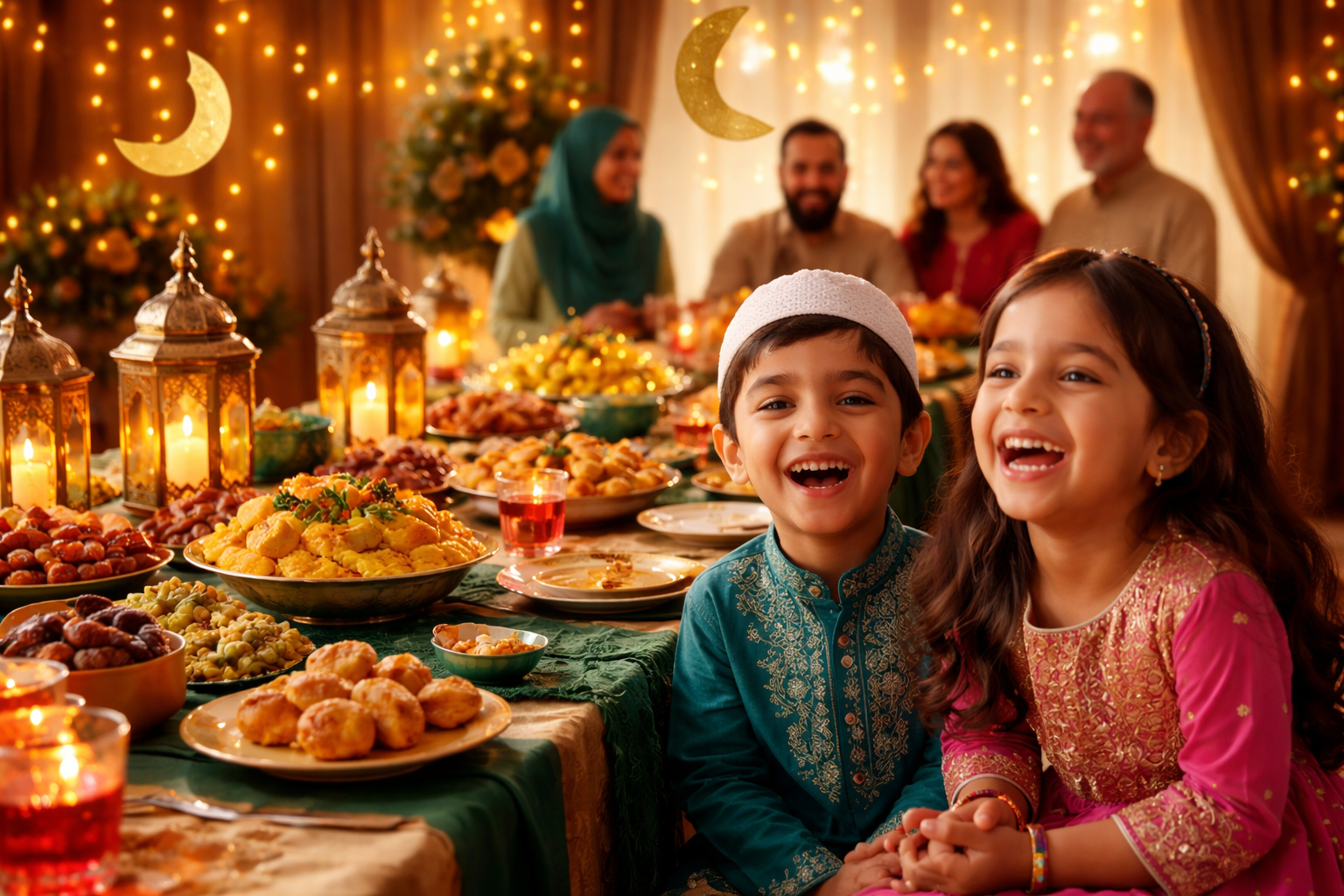
Decoration doesn't need to be elaborate or expensive — it needs to feel intentional and festive. Eid al-Fitr has a rich visual language: crescent moons, stars, lanterns, rich jewel tones like gold, emerald, and deep purple, and the Arabic calligraphy of "Eid Mubarak."
Simple but impactful decoration ideas:
- Hang a "Eid Mubarak" banner in gold and green at your entrance
- Use lanterns (fanoos) as centerpieces — they're inexpensive and instantly atmospheric
- Set up a small Eid photo corner with a backdrop, props, and good lighting — guests love it and it becomes a memory-making station
- Place small Eidi envelopes (for giving money to children) in a decorative bowl near the entrance
- Use cloth napkins and real serving dishes rather than disposables — it elevates the entire feel
If you have children attending, designate a kids' zone with coloring sheets featuring Islamic geometric patterns, a simple craft activity, or a small treasure hunt. Keeping children engaged means adults can actually have conversations.
Step 5: Structure Your Day So You Can Actually Enjoy It
The biggest mistake Eid hosts make is spending the entire day in the kitchen while guests enjoy themselves in the living room. Build a realistic day-of timeline:
- Eid morning (before guests arrive): Eid prayer, family photos in new outfits, light breakfast of dates and sheer khurma
- 2–3 hours before guests arrive: Final food prep, table setting, decoration check
- 30 minutes before: Get dressed, delegate final tasks to family members
- Guest arrival window: Greet guests, Eidi for children, light snacks and drinks available immediately
- Main meal time: Set a clear time for the main meal so food isn't sitting out for hours
- Dessert and tea: The social heart of the gathering — this is when conversations deepen
- Defined end time: Guests respect it when you've communicated it upfront
Delegate ruthlessly. Assign a family member to greet guests, another to manage the kids' zone, and another to handle drink refills. You cannot do everything.
Step 6: Handle the Eidi and Gift-Giving Gracefully
Eidi — giving money or small gifts to children — is one of the most beloved Eid traditions. Prepare in advance so it doesn't become awkward or unequal:
- Go to the bank before Eid and get crisp new bills — children love new notes
- Prepare envelopes in advance with set amounts by age group
- Have a few extra envelopes for unexpected young guests
- For adult gift exchanges, consider a simple "bring a wrapped gift under $20" white elephant format if your family enjoys it
Step 7: Capture the Memories
Eid gatherings are precious — children grow, relatives age, and not every year brings everyone together. Make memory-capturing intentional:
- Designate one person as the unofficial photographer (or hire one for larger gatherings)
- Take a full family group photo early — before anyone leaves
- Create a shared album link and share it in the family group chat so everyone gets the photos
- Consider a simple guest book or a "what are you grateful for this Ramadan?" card station
Your Eid Planning Checklist: 3 Things to Do Today
Planning a meaningful Eid al-Fitr celebration doesn't require perfection — it requires intention and a little organization. Here are your three next steps:
- 1. Write your guest list today. Open a notes app right now and write down every person you want at your Eid celebration. Don't edit — just list. You can refine later.
- 2. Send your invitations at least 2 weeks before Eid. Use a digital RSVP tool like RSVPlinks to create a beautiful, trackable invitation that makes it easy for guests to confirm — and easy for you to plan around real numbers.
- 3. Plan your menu based on confirmed guests, not assumptions. Once RSVPs are in, build your shopping list and assign potluck contributions. Food planning becomes simple when you know who's actually coming.
Eid al-Fitr is a celebration of gratitude, community, and the joy that comes after a month of discipline and reflection. With the right planning, you can be fully present for the laughter, the prayers, the food, and the people who make it meaningful — instead of spending the day stressed in the kitchen wondering how many plates you need.
Eid Mubarak — may your celebration be filled with barakah, love, and perfectly confirmed RSVPs.